
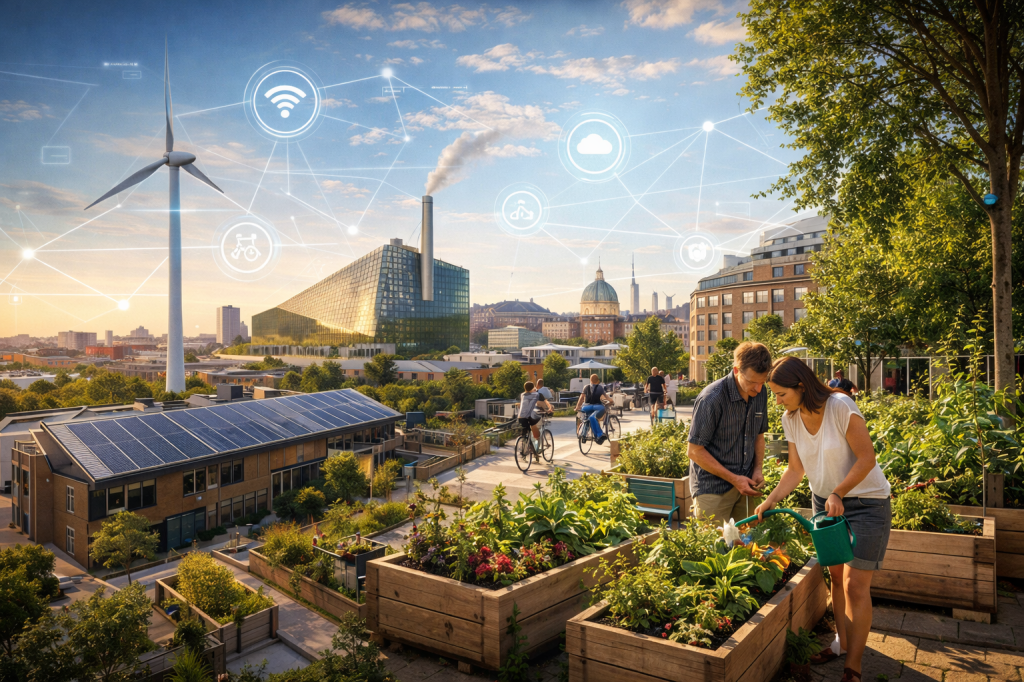
Sustainability, Climate Crisis, and the Responsibility of Smart Cities
This piece looks at smart cities not as technological showcases, but as urban systems increasingly shaped by climate pressure, sustainability priorities, and governance choices.
What does sustainability require from smart cities today?
Sustainability has become a central reference point in contemporary urban discourse. It appears across climate negotiations, European policy frameworks, and smart city strategies. Yet its growing visibility has not always translated into clarity. Sustainability is still too often framed as a long-term aspiration, while climate-related disruptions increasingly define the present.
Wildfires, floods, earthquakes, heatwaves, and infrastructure stress are no longer exceptional events. They shape everyday urban realities. In this context, discussions around smart cities require a shift in focus. Beyond efficiency and innovation, the question becomes how cities organise their technological, institutional, and governance capacities under conditions of risk and uncertainty.
Smart cities, therefore, cannot be understood solely as digitally enhanced environments. They are better examined as urban systems expected to operate amid disruption—where preparedness, coordination, and continuity matter as much as technological capability.
Digitalisation under climate pressure
Much of the smart city debate has historically prioritised digitalisation: sensors, platforms, real-time data, and automated systems.
While these elements are important, technology alone does not determine whether a city becomes more sustainable. Without clear priorities and governance frameworks, digitalisation risks remaining detached from pressing social and environmental challenges. From a sustainability perspective, the relevance of smart city technologies lies in how they support urban capacity: anticipating risks, coordinating responses, and maintaining essential services under stress. This involves not only technical performance, but also institutional coordination and public trust.
In climate-affected cities, the effectiveness of smart city solutions depends less on their visibility and more on their integration into everyday urban functions.
Sustainability beyond environmental indicators
Sustainability is often measured through environmental indicators such as emissions, energy efficiency, or resource use. While these dimensions remain essential, they do not fully capture the broader implications of smart city development.
A sustainable city must also consider how digital systems affect access to services, participation in decision-making, and the distribution of risks and benefits across different social groups. In this sense, sustainability intersects with governance and social equity. Smart city initiatives inevitably shape urban power relations, influencing whose needs are prioritised and whose vulnerabilities are addressed.
This perspective frames sustainability as a structuring principle rather than a sectoral policy goal requiring alignment between technological choices, institutional responsibility, and social inclusion.
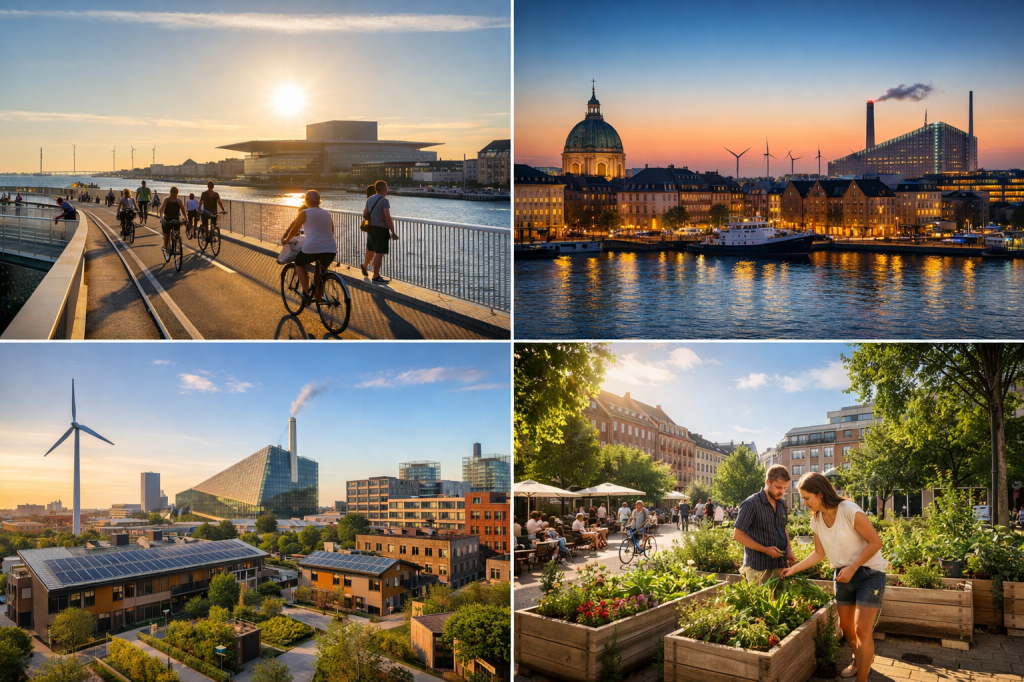
An illustrative case: Copenhagen
The relationship between sustainability and smart city development becomes more tangible when examined through specific urban contexts. Copenhagen offers an illustrative example of how digital technologies can be embedded within long-term climate and quality-of-life objectives.
In Copenhagen, smart city solutions are closely aligned with broader sustainability strategies, including ambitions for carbon neutrality and environmentally responsible urban living. Digital systems support energy management, sustainable mobility, and environmental monitoring, yet they are not positioned as central branding elements. Instead, they function as supporting infrastructures within a wider policy framework.
What is particularly notable is how sustainability is translated into everyday urban practices. Mobility systems, data-informed planning, and environmental technologies work together to support behavioural change without relying on constant technological visibility. In this context, smart technologies reinforce existing sustainability goals rather than redefining them.
Copenhagen’s experience suggests that smart city development gains relevance when digitalisation remains subordinate to clearly articulated environmental and social priorities. Technology serves as an enabling layer rather than a defining feature of urban identity.
Closing perspective
Rather than asking how smart cities can become more technologically advanced, the more relevant question today is how digital systems can remain aligned with sustainability priorities, governance responsibilities, and everyday urban realities.
This reflection draws on recent climate discussions within the COP process, European policy frameworks such as the EU Climate-Neutral and Smart Cities Mission, human-centred smart city assessments including the IMD Smart City Index, and comparative insights from my doctoral research on smart cities and urban communication.
The next posts in this series will explore how different cities translate these priorities into practice revealing where approaches converge, where tensions emerge, and what these choices mean for urban futures shaped by climate uncertainty.


 Şeyma Filiz