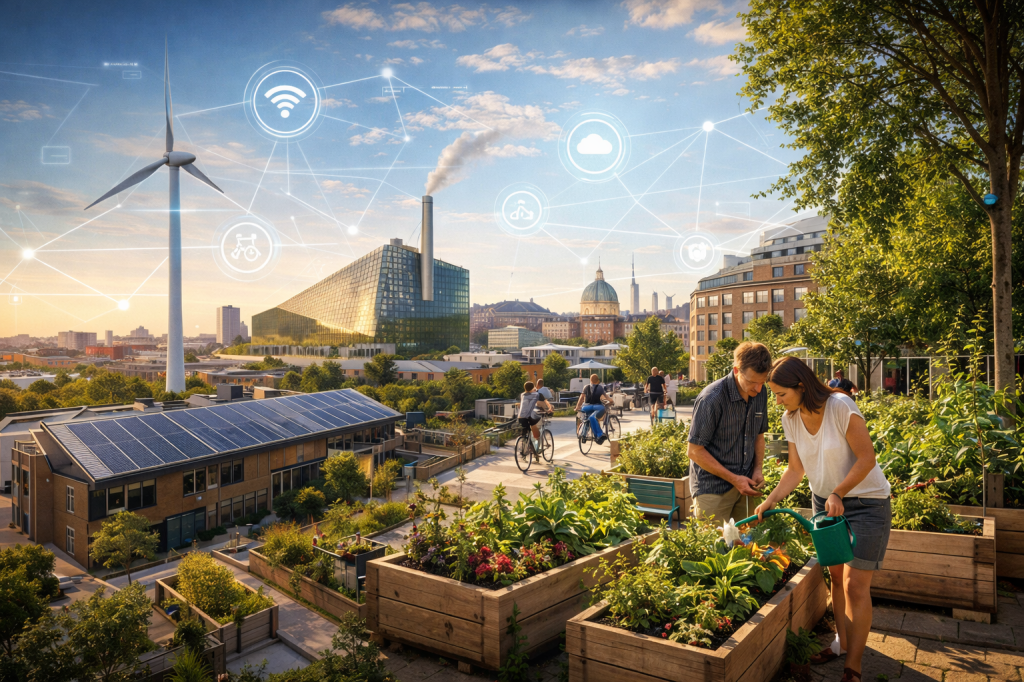
Category: smart-city

  • Smart Cities Series – II – Sustainability

    Smart Cities Series – II – Sustainability

    Sustainability, Climate Crisis, and the Responsibility of Smart Cities


    This piece looks at smart cities not as technological showcases, but as urban systems increasingly shaped by climate pressure, sustainability priorities, and governance choices.


    What does sustainability require from smart cities today?

    Sustainability has become a central reference point in contemporary urban discourse. It appears across climate negotiations, European policy frameworks, and smart city strategies. Yet its growing visibility has not always translated into clarity. Sustainability is still too often framed as a long-term aspiration, while climate-related disruptions increasingly define the present.

    Wildfires, floods, earthquakes, heatwaves, and infrastructure stress are no longer exceptional events. They shape everyday urban realities. In this context, discussions around smart cities require a shift in focus. Beyond efficiency and innovation, the question becomes how cities organise their technological, institutional, and governance capacities under conditions of risk and uncertainty.

    Smart cities, therefore, cannot be understood solely as digitally enhanced environments. They are better examined as urban systems expected to operate amid disruption—where preparedness, coordination, and continuity matter as much as technological capability.


    Digitalisation under climate pressure

    Much of the smart city debate has historically prioritised digitalisation: sensors, platforms, real-time data, and automated systems.

    While these elements are important, technology alone does not determine whether a city becomes more sustainable. Without clear priorities and governance frameworks, digitalisation risks remaining detached from pressing social and environmental challenges. From a sustainability perspective, the relevance of smart city technologies lies in how they support urban capacity: anticipating risks, coordinating responses, and maintaining essential services under stress. This involves not only technical performance, but also institutional coordination and public trust.

    In climate-affected cities, the effectiveness of smart city solutions depends less on their visibility and more on their integration into everyday urban functions.

    Sustainability beyond environmental indicators


    Sustainability is often measured through environmental indicators such as emissions, energy efficiency, or resource use. While these dimensions remain essential, they do not fully capture the broader implications of smart city development.

    A sustainable city must also consider how digital systems affect access to services, participation in decision-making, and the distribution of risks and benefits across different social groups. In this sense, sustainability intersects with governance and social equity. Smart city initiatives inevitably shape urban power relations, influencing whose needs are prioritised and whose vulnerabilities are addressed.

    This perspective frames sustainability as a structuring principle rather than a sectoral policy goal requiring alignment between technological choices, institutional responsibility, and social inclusion.
    An illustrative case: Copenhagen


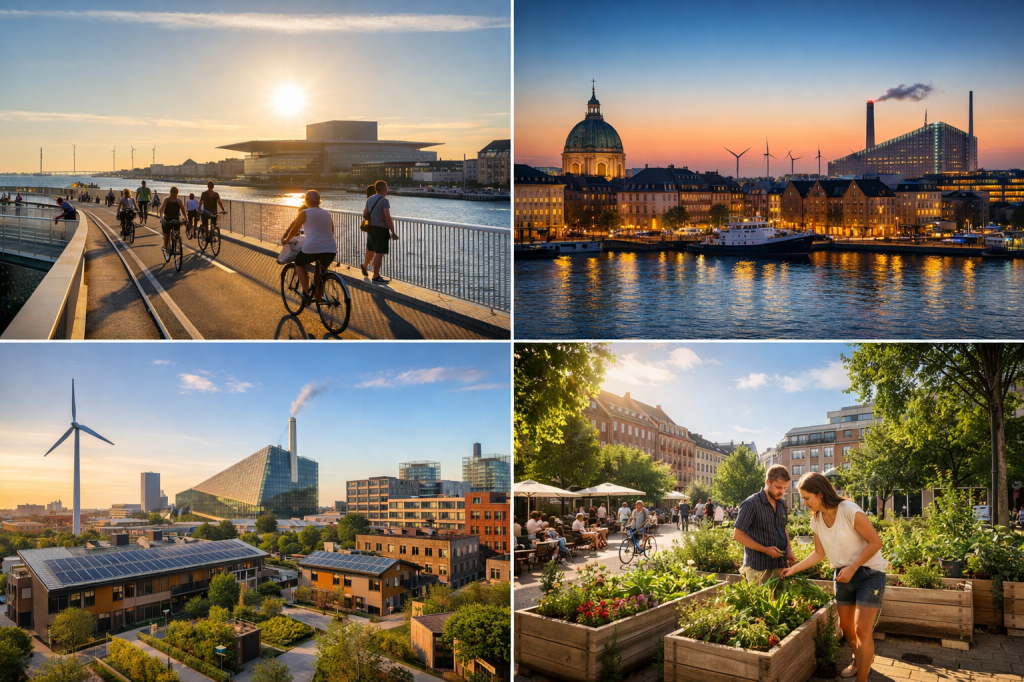
    The relationship between sustainability and smart city development becomes more tangible when examined through specific urban contexts. Copenhagen offers an illustrative example of how digital technologies can be embedded within long-term climate and quality-of-life objectives.

    In Copenhagen, smart city solutions are closely aligned with broader sustainability strategies, including ambitions for carbon neutrality and environmentally responsible urban living. Digital systems support energy management, sustainable mobility, and environmental monitoring, yet they are not positioned as central branding elements. Instead, they function as supporting infrastructures within a wider policy framework.

    What is particularly notable is how sustainability is translated into everyday urban practices. Mobility systems, data-informed planning, and environmental technologies work together to support behavioural change without relying on constant technological visibility. In this context, smart technologies reinforce existing sustainability goals rather than redefining them.

    Copenhagen’s experience suggests that smart city development gains relevance when digitalisation remains subordinate to clearly articulated environmental and social priorities. Technology serves as an enabling layer rather than a defining feature of urban identity.

    Closing perspective


    Rather than asking how smart cities can become more technologically advanced, the more relevant question today is how digital systems can remain aligned with sustainability priorities, governance responsibilities, and everyday urban realities.


    This reflection draws on recent climate discussions within the COP process, European policy frameworks such as the EU Climate-Neutral and Smart Cities Mission, human-centred smart city assessments including the IMD Smart City Index, and comparative insights from my doctoral research on smart cities and urban communication.


    The next posts in this series will explore how different cities translate these priorities into practice revealing where approaches converge, where tensions emerge, and what these choices mean for urban futures shaped by climate uncertainty.
  • Smart Cities Series – I – Smart City Branding

    Smart Cities Series – I – Smart City Branding

    Smart City Branding: What Can Smart Cities Really Change?


    What can smart cities really change?

    This question has stayed with me throughout my doctoral journey—not because it has a single answer, but because it keeps unfolding as cities adapt to technology, or are increasingly reshaped by it. Discussions around smart cities often emphasize efficiency, data, and innovation.

    Yet what remained with me most strongly is a simple insight:

    “Smart technologies are not neutral infrastructures. They actively participate in shaping how cities define themselves, how they are perceived, and how they position their futures.

    Technology-driven change rarely arrives with all its implications fully understood. Digital systems and platforms usually enter urban life first; governance models, ethical debates, and social reflections tend to follow later.

    Cities are no exception. Smart technologies begin reorganizing everyday urban experiences long before their broader social and communicative consequences are fully visible. From this perspective, smart cities cannot be reduced to technical systems alone.

    “They are better understood as communication ecosystems spaces where technology intersects with governance, institutions, citizens, visitors, and global audiences. What matters is not only which technologies are implemented, but how they are communicated, governed, and experienced.”

    This is where smart city branding becomes particularly visible. City branding is often associated with logos, slogans, or promotional campaigns. In reality, it is shaped by everyday experiences, narratives, and meanings that unfold over time.

    Smart technologies inevitably become part of these narratives. They influence what a city stands for, what it prioritizes, and how it imagines its future. Rather than emerging through isolated technological projects, smart city branding takes shape through a set of interrelated components.

    Smart Communication
    Smart communication plays a central role in how cities translate technological change into meaning. In cities like Seoul, digital technologies are not only functional tools but part of everyday urban life and cultural production. The integration of smart services with global cultural industries such as K-pop allows the city to project a dynamic, future-oriented identity where technology and culture reinforce each other.

    Stakeholders
    The way smart technologies shape city branding is closely linked to stakeholder involvement. Amsterdam demonstrates how collaboration between public institutions, start-ups, researchers, and citizens enables smart city initiatives to move beyond symbolic participation. Here, technology becomes a shared project rather than a top-down agenda, strengthening both governance and brand credibility.

    Smart Governance
    Governance models determine whether smart technologies enhance transparency or remain abstract promises. Cities such as Berlin and London reflect hybrid approaches, where digital innovation intersects with creative industries and cultural heritage. These cities negotiate continuity and change, producing multi-layered identities shaped by openness, creativity, and institutional complexity.

    Sustainability
    In some cities, sustainability provides the primary narrative through which smart technologies gain legitimacy. Copenhagen consistently positions itself as a carbon-neutral city, embedding digital solutions into long-term climate goals and quality-of-life narratives. Here, smart technologies reinforce a value-based brand identity rather than standing out as isolated innovations.

    Digital Infrastructure
    Digital infrastructure shapes who can participate in urban life and whose experiences are made visible. In contrast, Istanbul presents a strong cultural and historical narrative but remains in a transitional phase when it comes to integrating smart city technologies into its branding. Digital communication continues to foreground heritage and aesthetics, while technological infrastructures remain less visible within the city’s brand narrative.

    Smart Tourism
    Smart tourism mediates how cities present themselves to global audiences. In hybrid and transitional contexts, tourism communication often becomes the dominant branding channel, amplifying heritage and aesthetics while leaving smart infrastructures in the background.

    Taken together, these observations suggest that smart city branding is not about adopting the same technologies, but about how cities translate technology into meaning. The question is no longer whether a city is smart, but how smart technologies are aligned with values, governance, and everyday experience.

    This post opens the Smart Cities Series. In the next piece, I will move closer to smart city cases and tech-oriented updates, focusing on current developments, country examples, and emerging discussions shaping urban futures.

    Acknowledgement
    This reflection is informed by conversations and interviews conducted as part of my doctoral research. I am sincerely grateful to the city branding and smart city experts who generously shared their time, insights, and experiences.